


a seminar lecture – M.Sc. student in Landscape Architecture
Supervised by Prof Daniel Orenstein, Faculty of Architecture and Town Planning, Technion.
And Dr. Yakir Preisler, Plant Science, Volcani Institute, Agricultural Research Organization
Thursday 15.9.26
at 11:00 in the conference room 3ʳᵈ floor in Amado building and in zoom
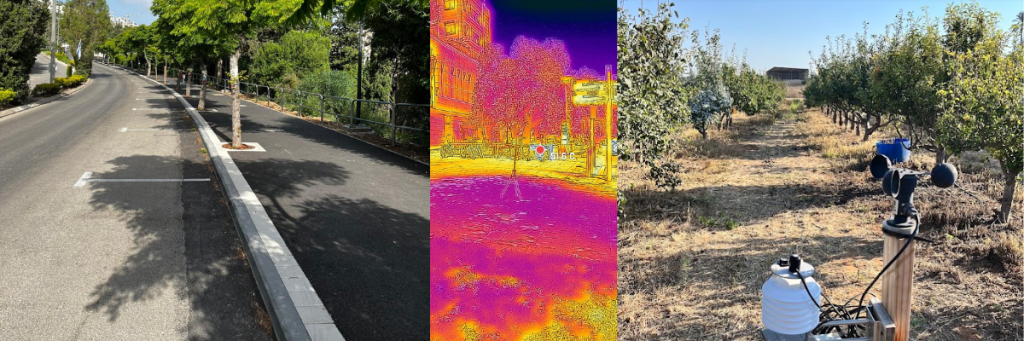
Trees are used to mitigate the Urban Heat Island effect, but the planning literature often conflates physiological transpiration with static shading. To isolate transpiration’s specific cooling effect, a controlled field experiment was conducted on mature trees at the Volcani Institute using chemical anti-transpirants and intensive radiation monitoring. While stomatal inhibition successfully reduced transpiration and increased leaf temperatures, it yielded no substantial changes in under-canopy mean radiant temperature or thermal comfort, indicating the need to investigate additional metrics to assess trees’ true cooling contributions accurately. A complementary analysis of ten urban forestry manuals revealed a “Science-Practice Gap”—guidelines frequently treat trees as inert infrastructure, overlooking their physiological needs. Ultimately, as dynamic biological systems, maximizing their cooling potential requires aligning planning with plant science, ensuring they receive the space, soil, and water needed to thrive.
Contact information: Ron Linder| 052-4204241| mail: Ron.Linder@campus.technion.ac.il